Education has always been about more than reading, writing, and math. Schools play an important role in preparing students for life, helping them develop the knowledge, character, and confidence they need to succeed beyond the classroom. While academic achievement remains essential, today’s educators understand that emotional well-being is just as important.
Students bring more than backpacks into school each morning. They bring their experiences, emotions, relationships, challenges, and hopes for the future. Some arrive excited to learn. Others may be dealing with anxiety, family struggles, bullying, or personal hardships that make focusing on school incredibly difficult.
This is why social-emotional learning, often called SEL, has become one of the most important investments schools can make. SEL helps students understand themselves, build healthy relationships, manage emotions, and make positive decisions. These aren’t simply “nice to have” skills—they’re life skills that influence everything from academic performance to future careers.
Schools that intentionally teach social-emotional learning create environments where students don’t just perform better academically. They become more compassionate, resilient, and prepared for the challenges they’ll face throughout life.
What Is Social-Emotional Learning?
Social-emotional learning is the process of helping students develop the emotional intelligence needed to succeed both inside and outside the classroom. It focuses on teaching students how to recognize emotions, manage stress, build healthy relationships, solve problems, and make responsible choices.
Rather than replacing traditional academics, SEL complements them. Students who understand how to regulate emotions and communicate effectively are better prepared to learn, collaborate, and overcome obstacles.
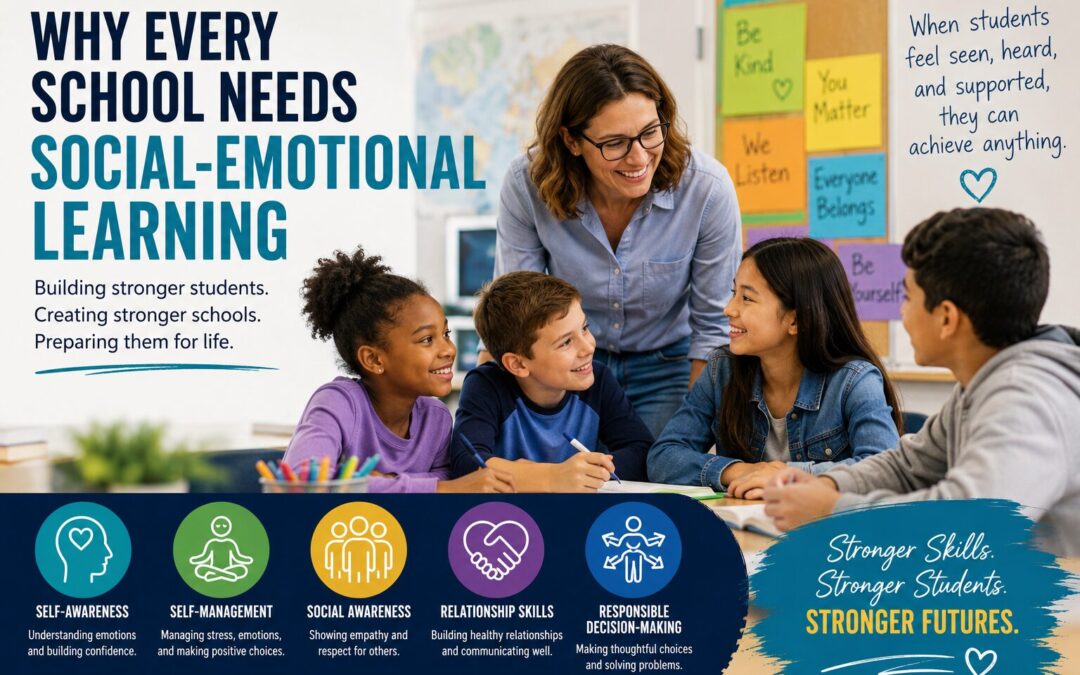
Most SEL programs focus on five key areas: self-awareness, self-management, social awareness, relationship skills, and responsible decision-making. Together, these competencies help students become more confident learners and more thoughtful members of their school communities.
Today’s Students Face More Challenges Than Ever
Modern students are growing up in a world that moves faster than any generation before them. Social media, constant digital communication, academic pressure, and uncertainty have created new challenges that many previous generations never experienced during childhood.
Many students also carry emotional burdens that aren’t immediately visible. Family instability, financial stress, mental health concerns, grief, trauma, and bullying can all affect how students behave and learn.
Without the skills to process these experiences, emotions often appear as disruptive behavior, disengagement, anxiety, or conflict with peers.
Social-emotional learning provides students with practical tools for navigating these challenges. Instead of reacting impulsively, students learn how to pause, reflect, communicate, and solve problems in healthier ways.
Academic Success Begins With Emotional Safety
Learning requires vulnerability.
Students ask questions, make mistakes, participate in discussions, and attempt difficult tasks every day. They can only do these things confidently when they feel emotionally safe.
Classrooms built on trust encourage curiosity instead of fear. Students become willing to participate because they know mistakes are viewed as opportunities for growth rather than reasons for embarrassment.
Research continues to show that students who feel emotionally supported demonstrate greater engagement, stronger attendance, and higher academic achievement.
SEL helps create that emotional foundation by teaching both students and educators how to build respectful, supportive classroom environments.
Social-Emotional Learning Improves Student Behavior
One of the biggest misconceptions about SEL is that it’s only about feelings.
In reality, strong emotional skills directly influence behavior.
Students who understand how to recognize frustration are less likely to lash out. Students who know how to communicate respectfully are better equipped to resolve disagreements before they escalate. Students who practice empathy are more likely to support classmates rather than exclude them.
Schools that consistently integrate SEL often experience reductions in disciplinary referrals, bullying incidents, classroom disruptions, and physical conflicts.
Instead of simply reacting to negative behavior, schools begin addressing the reasons behind it.
This shift creates lasting change because students develop healthier habits instead of simply learning how to avoid punishment.
Teachers Benefit From SEL Too
Social-emotional learning isn’t only for students.
Teachers face increasing demands every year. They balance instruction, assessment, classroom management, parent communication, and countless responsibilities that extend beyond academics.
Professional development centered on SEL gives teachers practical strategies for building relationships, managing classroom dynamics, and supporting students experiencing emotional challenges.
Teachers also benefit personally by strengthening communication skills, reducing stress, and building stronger connections with colleagues and students.
When educators feel supported emotionally, they’re better equipped to support their students.
Strong Relationships Create Strong Schools
Every successful school shares one common characteristic: strong relationships.
Students thrive when they trust their teachers.
Teachers thrive when they feel supported by administrators.
Parents thrive when they feel connected to the school community.
SEL strengthens every one of these relationships.
Schools that prioritize emotional intelligence create cultures where people feel respected, heard, and valued. Those positive relationships become the foundation for academic achievement, leadership, and long-term success.
Social-Emotional Learning Supports School Safety
School safety involves much more than physical security.
Students must also feel emotionally safe.
Many behavioral issues begin long before they become visible. Feelings of isolation, rejection, anger, or hopelessness often develop gradually.
SEL helps educators identify these warning signs earlier by encouraging communication, empathy, and meaningful relationships.
When students know trusted adults are available to listen, they’re more likely to seek help before problems escalate.
Creating emotionally connected schools is one of the most effective ways to strengthen overall campus safety.
Storytelling Makes SEL More Meaningful
One of the most effective ways to teach social-emotional learning is through storytelling.
Stories create emotional connections that lectures often cannot.
When students hear authentic stories about overcoming adversity, building resilience, and finding purpose, they begin seeing their own experiences differently. They realize they aren’t alone.
Many schools have found tremendous success using programs that combine storytelling with social-emotional learning.
Organizations like TEEN TRUTH’s School Assembly Youth Empowerment Program help schools introduce these conversations through authentic student-centered assemblies that encourage empathy, honesty, and connection.
Rather than simply talking about emotional intelligence, storytelling allows students to experience it.
Making SEL Part of Everyday Learning
The most successful schools don’t treat social-emotional learning as a separate subject.
Instead, SEL becomes part of the school’s culture.
Teachers reinforce emotional skills during classroom discussions. Administrators model respectful communication. Students practice empathy through collaboration, leadership opportunities, and daily interactions.
This consistent approach helps students apply emotional intelligence naturally rather than viewing it as another lesson to memorize.
Schools looking to integrate these concepts throughout the year often benefit from structured resources like the TEEN TRUTH SEL Curriculum Program, which provides educators with ongoing lessons and activities designed to strengthen school culture while supporting student growth.
When SEL becomes woven into everyday learning, the impact reaches every classroom.
Preparing Students for Life Beyond Graduation
Academic knowledge opens doors.
Emotional intelligence determines how students walk through them.
Employers consistently rank communication, teamwork, adaptability, leadership, and problem-solving among the most valuable workplace skills.
These are all strengthened through social-emotional learning.
Students who develop emotional intelligence become stronger collaborators, better leaders, and more resilient adults. They learn how to navigate disagreements, manage stress, build relationships, and make thoughtful decisions throughout life.
Schools that invest in SEL aren’t simply preparing students for their next test.
They’re preparing them for adulthood.
The Long-Term Benefits of SEL
The effects of social-emotional learning extend far beyond graduation.
Students who develop emotional intelligence often experience stronger relationships, improved mental health, greater confidence, and increased career success throughout adulthood.
Communities also benefit.
Schools that prioritize empathy, respect, and collaboration help develop citizens who contribute positively to their workplaces, neighborhoods, and families.
The ripple effect begins with a single classroom but extends throughout an entire community.
Frequently Asked Questions About Social-Emotional Learning
What is social-emotional learning?
Social-emotional learning (SEL) is the process of teaching students skills like emotional awareness, relationship building, responsible decision-making, empathy, and self-management. These skills help students succeed both academically and personally.
Why is SEL important in schools?
SEL helps students improve behavior, strengthen relationships, reduce stress, and become more engaged learners. Schools that prioritize SEL often experience better school culture, fewer disciplinary issues, and stronger academic performance.
Does social-emotional learning improve academic achievement?
Yes. Students who feel emotionally supported are generally more engaged in learning, participate more actively, and perform better academically because they’re able to focus on learning rather than unmanaged emotional challenges.
How does SEL help teachers?
SEL provides teachers with strategies to build stronger relationships, improve classroom management, reduce conflict, and create supportive learning environments where students can thrive.
Can SEL reduce bullying and school violence?
While no single program eliminates bullying or violence, SEL helps students develop empathy, communication skills, and emotional regulation that often reduce conflicts before they escalate.
Is social-emotional learning appropriate for all grade levels?
Absolutely. SEL can be adapted for elementary, middle, and high school students. The core skills remain the same while activities become age-appropriate for different developmental stages.
How can schools successfully implement SEL?
The most successful schools make SEL part of everyday culture rather than treating it as a standalone lesson. Professional development, consistent modeling by staff, and ongoing curriculum support all contribute to long-term success.
Why do school assemblies work well with SEL?
Assemblies that use authentic storytelling help students connect emotionally with important topics like empathy, resilience, leadership, and belonging. These experiences often create lasting conversations that continue long after the event ends.
The Bottom Line: SEL Builds Better Schools
Social-emotional learning is no longer an optional addition to education—it’s an essential part of helping students succeed in today’s world.
Academic excellence and emotional well-being are not competing priorities. They work together.
When students learn to understand themselves, build healthy relationships, communicate effectively, and overcome challenges with resilience, every part of school improves. Classrooms become more positive. Teachers build stronger connections. Students become more engaged. Entire school communities grow stronger.
The schools making the greatest impact today understand that educating the whole child means developing both the mind and the heart.
Because when students feel connected, supported, and understood, they’re not just better learners—they become better leaders, better friends, and better people.